FHA STREAMLINES REFINANCE GUIDELINES IN KENTUCKY 2015


https://entp.hud.gov/idapp/html/hicost1.cfm

When Should You Refinance Your Mortgage?


When Should You Refinance Your Mortgage?

RealtorPegSanDiego's avatarSan Diego with RealtorPeg

Some homeowners are understandably eager to refinance their mortgage loans and acquire a better rate. But instead of jumping into a refinance too fast, take time to assess your situation to see if now’s the right time to create a new mortgage loan. Lenders use numerous factors to determine the rate on your home loan. Preparing for a re-fi is key to getting the terms you want and deserve.

Know Your Credit Score

  • Myfico.com is the source to receive your personal credit score. Checking your score before refinancing is imperative because lenders use this three-digit number to determine eligibility and the mortgage rate on the new loan. A large percentage of owners refinance to lower their existing rate, but if your rate doesn’t fall within a certain range, you may not qualify for the most favorable terms. Refinance your mortgage loan when you’ve improved your score to 740 or higher…

View original post 277 more words

5 Ways to Jumpstart Your Credit Score in 2017


5 Ways to Jumpstart Your Credit Score in 2017

1. Become an Authorized User
“One tried-and-true trick is to have someone with great credit add you as an authorized user to a card that they’ve had for a long time,” says Casey Fleming, author of The Loan Guide: How to Get the Best Possible Mortgage.

Using this method, you can piggyback off someone else’s good credit. Authorized users benefit from responsibly managed accounts because these accounts will be listed on the user’s credit report. But both you and the account holder need to be wary – if they aren’t as financially responsible as you think, or if they use their card irresponsibly, your plan can backfire and both credit scores could suffer. (Note: Authorized users can request delinquent accounts be removed from their credit reports; primary cardholders not-so-much, so be sure you’re not overcharging.)

2. Request a Credit Limit Increase
You can ask your credit card providers to increase the limits on all the cards you own. If you have a history of timely payments with your credit card provider, there’s a good chance they will negotiate. By increasing your credit limits, you’ll be improving yourcredit utilization rate, which is the amount of debt you’re carrying versus your total credit limits — and is a major contributing factor to your credit score.

Note: This will only work if you don’t increase your spending. If your credit card issuer raises your limit by $1,000, and you immediately start racking up charges that eat up the difference, the increased limit won’t do much good. Experts recommend keeping your credit card usage at no more than 30%, with an ideal balance at 10%. (You can check your credit utilization rate by viewing two of your free credit scores on Credit.com.)

Keep in mind, too, a request for a credit limit increase could result in a hard inquiry on your credit report, which can ding your credit scores, so use this strategy carefully.

3. Pay Down Your Cards
To the point above, your credit utilization rate will also improve if you pay down your credit card balances. If you have some extra funds, consider making extra payments on your credit card rather than dropping $100 at Chili’s this weekend. Doing the former can make a real difference and is a decision you’re unlikely to regret.

“Paying down your credit card balances to under 30% of the limits” will net results, says Fleming.

4. Check for Credit Report Errors
There could be an error on your credit reports that are weighing your scores down — and, is so, its removal could quickly improve your standing. You can pull your credit reports for free each year at AnnualCreditReport.com. If something is amiss, be sure to dispute it with the credit reporting agency in question. Most credit report disputes must be resolved in 30 days; a few can take up to 45 days. You can learn more about disputing errors on your credit report here.

5. Ask About Rapid Rescoring
If you’re applying for a mortgage, one lesser-known trick is to ask your lender about a rapid rescore. Rapid rescoring services are usually provided by mortgage lenders when applicants are on the cusp of qualifying for a better interest rate.

Rapid rescoring can to help update credit reports or fix errors quickly. If you recently paid off a debt, or have proof that a negative item on your credit report is inaccurate, you can provide that documentation to the lender. The lender will then request a rapid rescore on your behalf, and either absorb the cost or pass it on to you. You’ll want to ask your lender ahead of time whether you should expect charges for the service.

“If you are working with a mortgage company for a loan, they would handle this for you and it should not [drastically] mark up the costs,” says Tal Frank, president of PhysicianLoans, a niche mortgage company. “The rescore is the quickest way to see a change in your score once balances have been paid down and repairs have been made. It can be as quick as a one- or two-day turnaround time.”

http://blog.credit.com/2016/12/4-ways-to-boost-your-credit-score-164102/

Rapid Rescore Credit Repair by Jason Hall's avatarRapid Rescore

1. Become an Authorized User

“One tried-and-true trick is to have someone with great credit add you as an authorized user to a card that they’ve had for a long time,” says Casey Fleming, author of The Loan Guide: How to Get the Best Possible Mortgage.

Using this method, you can piggyback off someone else’s good credit. Authorized users benefit from responsibly managed accounts because these accounts will be listed on the user’s credit report. But both you and the account holder need to be wary – if they aren’t as financially responsible as you think, or if they use their card irresponsibly, your plan can backfire and both credit scores could suffer. (Note: Authorized users can request delinquent accounts be removed from their credit reports; primary cardholders not-so-much, so be sure you’re not overcharging.)

2. Request a Credit Limit Increase

You can ask your credit card providers to increase…

View original post 538 more words

Kentucky FHA Loans Compared to Kentucky Conventional Loans


When it comes to financing a home a buyer is faced with the decision of what type of loan they want. The two most common choices are FHA or Conventional. Both have their advantages and disadvantages. Follow the chart below to see which one is a fit for you! For more information on homes available … Continue reading Kentucky FHA Loans Compared to Kentucky Conventional Loans

Who Pays Closing Costs?


What are closing costs?

Simply put, closing costs are fees and expenses that are associated with processing and closing a real estate transaction. The majority of these fees are charged to the buyer for loan origination, loan processing, and title services, however the seller will also have a few small charges for transferring and recording the deed, as well as fees from the closing attorney for using their services. The seller also pays the Realtor commissions.

Buyer Breakdown

Depending on the bank / lender you use, the following fees could be considered closing costs when buying a home:

Loan Origination Fee – this is what your loan officer or bank charges to create the loan.
Points – You don’t have to take the interest rate that is quoted to you. You can choose to buy a rate. If you pick an interest rate that is lower than the current market rate, you will pay “points”.
Credit Report – The bank has to review your credit before giving you a loan. The bank / lender pays a fee for pulling your credit, and they usually pass this small fee on to the buyer.
Flood Certification – This is also pulled by the lender to determine whether or not the home you are buying is in a flood plain.
Appraisal Fee – This is typically paid out of pocket before you even get to closing, however some lenders will allow it to be paid at closing.
Title Services – A title agency examines the deed of the property you are buying. They look way back into the past to make sure that no one else owns the home, and that no liens have been placed on the home.
Title Insurance – Since the title services are performed by human beings, it is possible that an error could be made. Title insurance protects the buyer against paying for these errors.
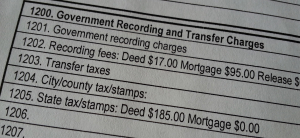
Government Recording Fees – The government charges fees to record the deed and mortgage at the courthouse.
Seller Breakdown

Settlement / Closing Fee – This is paid to the closing attorney for their services. Every real estate transaction needs a closer to reside over it.
City/County/State Tax – A transfer tax that is charged to the seller for transferring the deed. One dollar is charged per every thousand dollars of the sale price. ($185,000 home = $185 state tax)
Realtor Commission – The Realtor’s services are paid for by the seller of the home. This commission is agreed upon before the home ever goes on the market, but is only paid if the home actually closes. Therefore this money comes out of the seller’s proceeds at the end of the transaction.
Lopsided View

While the number of fees associated with buying a home is larger than with selling, the dollar amount of the fees could actually be much higher on the selling side. So, why do so many buyers feel like the seller should cover all or part of their closing costs? The only answer I have is TV. People watch HGTV for a couple hours and all of a sudden they think that sellers are just expected to pay the buyer’s closing costs. Well, yes and no.

So who should pay them?

I like for my buyers to be prepared to pay their own closing costs for two reasons: 1) it makes your offer stronger by showing the seller of the home that you can afford to buy the house, and pay the costs associated with it. 2) it gives us more negotiating power later down the road if the seller needs a favor from us.
HOWEVER…
There are plenty of instances where a buyer is completely qualified to purchase a home, but unable to bring a large sum of cash to the table. I get it. In that instance, I tell my buyers that we need to focus on the NET number of dollars to the seller. You see, sellers don’t mind paying a buyer’s closing costs if it makes sense to the bottom line for the seller to do so. A buyer that says, “I will not pay more than $183,000 for that house” needs to make sure that what they are offering is actually $183,000. If that buyer is offering $183,000 but also asking for $4,000 to be paid toward their closing costs, then that buyer isn’t actually offering $183,000. They are offering $179,000 ($183,000-$4,000). No matter how you slice it, or where the money goes, the bottom line to that seller is what they are walking away with. So if this buyer truly needs the $4,000 for closing costs because they just don’t have the money, I would tell them to offer $187,000 and ask for $4,000 to be paid toward their closing costs, creating the true NET of $183,000.

Justin Thomas's avatarHighlands Home Place

HUDWhether you’re buying a home or selling a home, you will most likely encounter some sort of question regarding closing costs.  Who pays them?  What do they include?  Why do I have to pay them?  There are a lot of different ways that closing costs can affect the outcome of a home sale, and there isn’t really a standard practice when it comes to these customary expenses.  Nonetheless, consumers often have a skewed perspective on what these costs are, and who is responsible for them.  Here are the facts about closing costs.

What are closing costs? 

Simply put, closing costs are fees and expenses that are associated with processing and closing a real estate transaction. The majority of these fees are charged to the buyer for loan origination, loan processing, and title services, however the seller will also have a few small charges for transferring and recording the deed, as…

View original post 789 more words